EN
EN
WHY MICROCRYSTAL
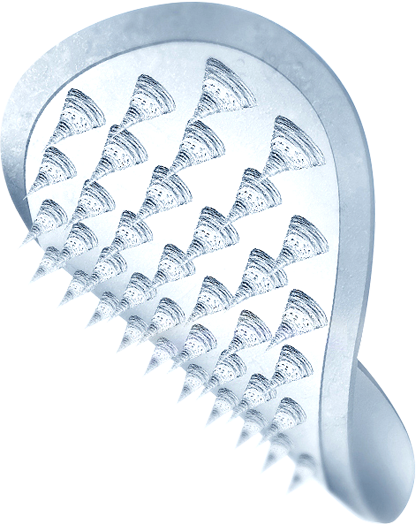
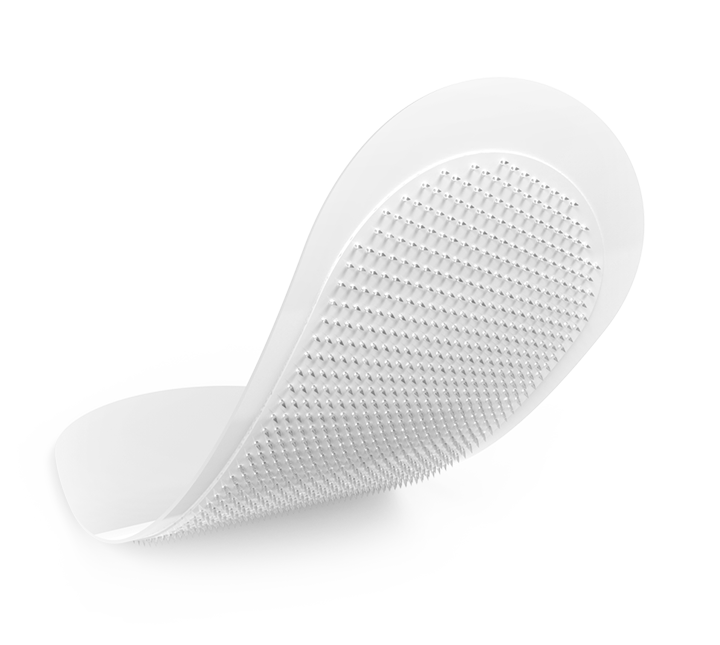
The microcrystalline system encompasses multiple structural types, such as solid microcrystals, hollow microcrystals, coated microcrystals, soluble microcrystals, and swelling microcrystals. Building on its own R&D expertise, BIOQINGLAM is optimistic about the application of soluble microcrystal technology in the fields of deep penetration of active ingredients and skin condition assessment. Microcrystalline penetration-enhancing technology is both a practical science and a results-oriented technology.
-
 Painless, less invasive, better compliance Height<450 μm, pricks stratum corneum only to reach lymphatic fluid in Epidermal layer, no contact with neurons or blood vessels in dermal, so patients won’t feel.
 -
 Less side effects, better safety Avoiding gastrointestinal side effects or the first pass effect of the liver. API still need to pass through several biological barriers
 -
 Easy to use, transport, and store Solid dosage form, good stability, no need for cold chain, Band-Aid kind of use
 -
 Various API can be delivered Peptide, Proteins(including anti-bodies), DNA/RNA, SMEs
THE SCIENCE
The Science
Technical Principles
The microcrystal transdermal delivery system delivers active ingredients through the body's surface skin, making it the most convenient and user-compliant transdermal delivery method. However, for decades, the industrialization of this technology has remained extremely challenging worldwide — a testament to the immense difficulty of bringing it to fruition.
Here are several core challenges:
1. Loading Capacity
Like all dosage forms, it is a combination of multiple ingredients — except that this time they are formed into microcrystals using molds rather than compressed into tablets, and these microcrystals deliver the active ingredients through the skin to the epidermal layer, where they dissolve. Painlessness and minimal invasiveness are the original design goals, so the microcrystals must be extremely small, which leaves very limited space to contain active ingredients. At the same time, due to its invasive principle, the patch size cannot be arbitrarily increased. A 1-milligram loading capacity has long been an insurmountable ceiling for many challengers.
2. Mechanical Strength of Crystals
Mechanical strength is a critical factor in penetrating the stratum corneum and reaching the epidermal layer. If the microcrystals cannot meet the strength requirements to accomplish this task, delivery will ultimately fail. The stratum corneum varies significantly across different animal species (including humans). The mechanical strength of the microcrystals must be delicately balanced to compensate for these differences. It must also be effective enough on any part of the human body while consistently delivering required pharmacokinetic/pharmacodynamic (PK/PD) results. This may also be one of the key reasons for poor consistency in clinical trials.
3. Efficiency of Microcrystal Delivery
The microcrystal transdermal delivery system is an excellent delivery method, but efficiency is always the foundation of everything. Before rushing into subsequent studies, developers must first understand the pattern of microcrystal efficiency changes. Efficiency may be more than sufficient in mice or rats, but it declines rapidly as animal models get closer to humans. What makes it worse is that low efficiency usually requires greater loading capacity to compensate — while loading capacity itself is already stretched thin. This will ultimately push the project toward failure.
4. Uniformity of Results
The principle of the microcrystal transdermal delivery system is easy to understand but extremely difficult to implement. Uniformity is the soul of this platform, and the industry's track record in this regard has been less than ideal. Individual differences introduce significant uncertainty to efficacy — this is also the core reason why we have yet to see a single microcrystal transdermal delivery product successfully launched. In June 2022, ZOSANO (NASDAQ: ZSAN) declared bankruptcy; its clinical asset was challenged by the FDA, with individual variability being the root cause.
This is another major challenge facing all researchers in the field of microcrystal transdermal delivery systems. Currently, there is no reliable supplier of dedicated equipment for this platform anywhere in the world. Designing a uniform, sterile GMP facility, along with a supporting quality system, is a prerequisite for developing microcrystal products.
The microcrystal transdermal delivery system is an extraordinarily complex academic, technical, and engineering system, involving multiple disciplines such as pharmaceutics, chemistry, materials science, mechanical equipment, technology, and engineering. Soluble microcrystals are a complex new delivery dosage form — more complex than lipid nanoparticles (LNP) or poly(lactic-co-glycolic acid) (PLGA) — and may be the most challenging task ever undertaken. After all, the theories behind LNP and PLGA were proposed later, yet have already been validated. The core issue here lies in the industrialization of this technology, rather than isolated studies at the laboratory level. It requires systematic knowledge, theory, and teams to achieve.
BioQingLam values and respects the difficulty and unique characteristics of this technology. We have assembled professional talents across formulation, process, equipment development, mold development, quality control, GMP compliance, and other areas. All work strictly follows the systematic methodology guidance of Design for Six Sigma (DFSS), integrating product development and production compliance requirements throughout the entire technical process.
Here are some of the indicators we have already achieved:
Continually increasing loading capacity: A single coin-sized patch can carry up to 15mg of active ingredient
Improved bioavailability with narrowed variability: taking semaglutide as an example, >90% in rats and ~61% in humans
High loading capacity for small-molecule materials, supporting multiple strength specifications
Content uniformity: A+2.2S < 15, meeting the most stringent regulatory requirements
Regulatory compliance: Currently the world's only sterile GMP facility for microcrystals, with all facilities custom-built
Technical Principles
The microcrystal transdermal delivery system delivers active ingredients through the body's surface skin, making it the most convenient and user-compliant transdermal delivery method. However, for decades, the industrialization of this technology has remained extremely challenging worldwide — a testament to the immense difficulty of bringing it to fruition.
Here are several core challenges:
1. Loading Capacity
Like all dosage forms, it is a combination of multiple ingredients — except that this time they are formed into microcrystals using molds rather than compressed into tablets, and these microcrystals deliver the active ingredients through the skin to the epidermal layer, where they dissolve. Painlessness and minimal invasiveness are the original design goals, so the microcrystals must be extremely small, which leaves very limited space to contain active ingredients. At the same time, due to its invasive principle, the patch size cannot be arbitrarily increased. A 1-milligram loading capacity has long been an insurmountable ceiling for many challengers.
2. Mechanical Strength of Crystals
Mechanical strength is a critical factor in penetrating the stratum corneum and reaching the epidermal layer. If the microcrystals cannot meet the strength requirements to accomplish this task, delivery will ultimately fail. The stratum corneum varies significantly across different animal species (including humans). The mechanical strength of the microcrystals must be delicately balanced to compensate for these differences. It must also be effective enough on any part of the human body while consistently delivering required pharmacokinetic/pharmacodynamic (PK/PD) results. This may also be one of the key reasons for poor consistency in clinical trials.
3. Efficiency of Microcrystal Delivery
The microcrystal transdermal delivery system is an excellent delivery method, but efficiency is always the foundation of everything. Before rushing into subsequent studies, developers must first understand the pattern of microcrystal efficiency changes. Efficiency may be more than sufficient in mice or rats, but it declines rapidly as animal models get closer to humans. What makes it worse is that low efficiency usually requires greater loading capacity to compensate — while loading capacity itself is already stretched thin. This will ultimately push the project toward failure.
4. Uniformity of Results
The principle of the microcrystal transdermal delivery system is easy to understand but extremely difficult to implement. Uniformity is the soul of this platform, and the industry's track record in this regard has been less than ideal. Individual differences introduce significant uncertainty to efficacy — this is also the core reason why we have yet to see a single microcrystal transdermal delivery product successfully launched. In June 2022, ZOSANO (NASDAQ: ZSAN) declared bankruptcy; its clinical asset was challenged by the FDA, with individual variability being the root cause.
This is another major challenge facing all researchers in the field of microcrystal transdermal delivery systems. Currently, there is no reliable supplier of dedicated equipment for this platform anywhere in the world. Designing a uniform, sterile GMP facility, along with a supporting quality system, is a prerequisite for developing microcrystal products.
The microcrystal transdermal delivery system is an extraordinarily complex academic, technical, and engineering system, involving multiple disciplines such as pharmaceutics, chemistry, materials science, mechanical equipment, technology, and engineering. Soluble microcrystals are a complex new delivery dosage form — more complex than lipid nanoparticles (LNP) or poly(lactic-co-glycolic acid) (PLGA) — and may be the most challenging task ever undertaken. After all, the theories behind LNP and PLGA were proposed later, yet have already been validated. The core issue here lies in the industrialization of this technology, rather than isolated studies at the laboratory level. It requires systematic knowledge, theory, and teams to achieve.
BioQingLam values and respects the difficulty and unique characteristics of this technology. We have assembled professional talents across formulation, process, equipment development, mold development, quality control, GMP compliance, and other areas. All work strictly follows the systematic methodology guidance of Design for Six Sigma (DFSS), integrating product development and production compliance requirements throughout the entire technical process.
Here are some of the indicators we have already achieved:
Continually increasing loading capacity: A single coin-sized patch can carry up to 15mg of active ingredient
Improved bioavailability with narrowed variability: taking semaglutide as an example, >90% in rats and ~61% in humans
High loading capacity for small-molecule materials, supporting multiple strength specifications
Content uniformity: A+2.2S < 15, meeting the most stringent regulatory requirements
Regulatory compliance: Currently the world's only sterile GMP facility for microcrystals, with all facilities custom-built
Principle of Microcrystalline Transdermal Delivery System